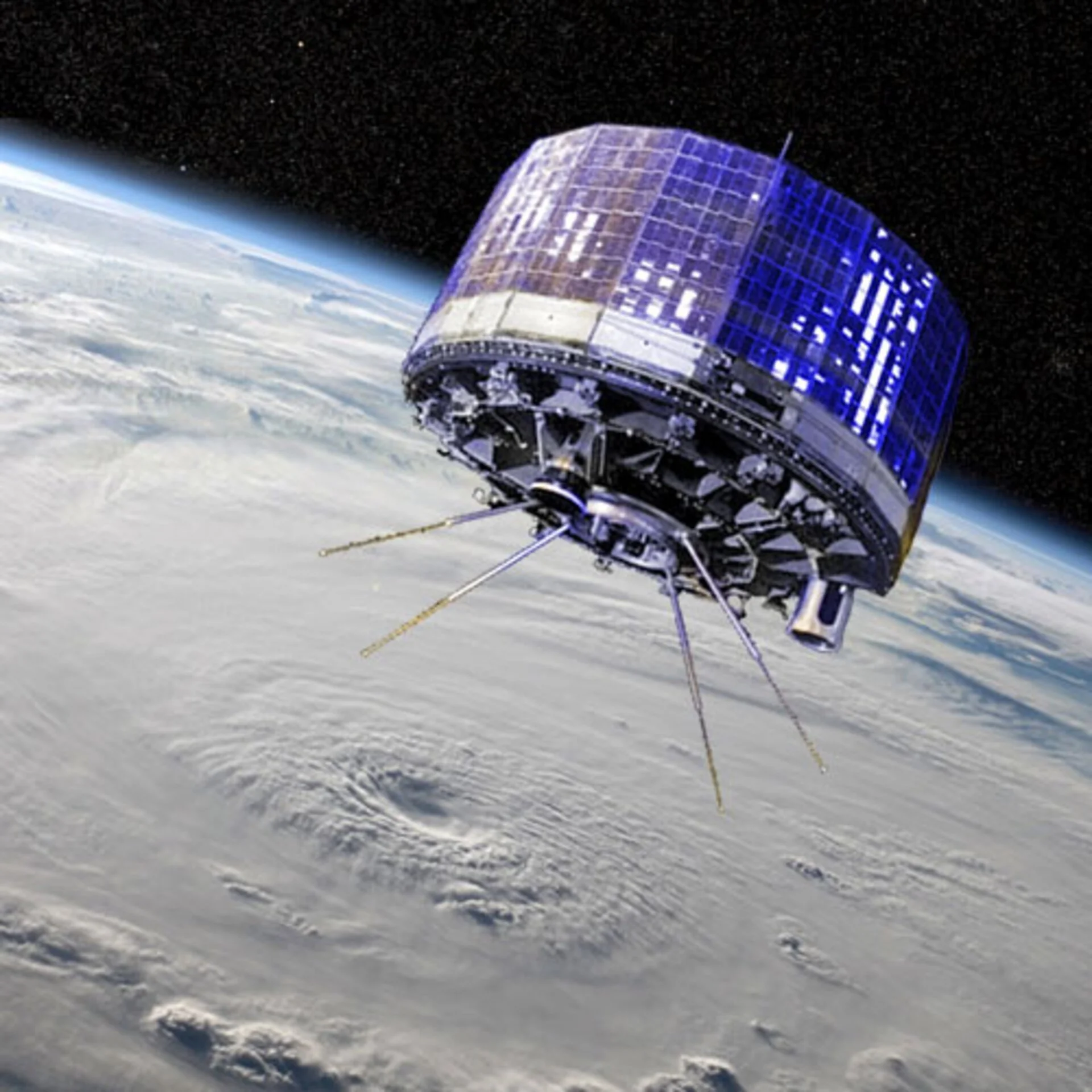

Flexco Microwave has provided high-performance coaxial cable assemblies to Level "S" space quality standards since 1974, supporting programs including TIROS, DMSP, and SATCOM. Flexco's quality management system is certified to ISO 9001:2015 and structured for AS9100D compliance, and our experienced assembly staff is certified to IPC-J-STD-001.
Flexco's Performance Series
Flexco's sealed outer conductor is formed with a continuous copper strip and a completely soldered seam. The conductor does not rely on surface contact area for its operation and is unaffected by oxidation. Field data from NASA's Long Duration Exposure Facility (LDEF) confirms that Flexco cable assemblies are not electrically degraded by surface oxidation over time. Exterior braiding and/or jacketing further eliminates oxidation risk and provides added protection against handling damage, micrometeoroids, and orbital debris.
Material Characteristics
Flexco Microwave RF cable assemblies are engineered to meet the materials and environmental requirements demanded by NASA and the broader space/satellite industry. All non-metallic materials used in Flexco assemblies — including dielectrics, jacketing, and potting compounds — are selected and screened per ASTM E595 outgassing criteria, meeting NASA's low-outgassing thresholds of ≤1.0% Total Mass Loss (TML) and ≤0.1% Collected Volatile Condensable Materials (CVCM), consistent with NASA Reference Publication 1124 (Outgassing Data for Selecting Spacecraft Materials). This ensures assemblies will not contaminate sensitive optics, thermal control surfaces, or adjacent electronics through vacuum outgassing.
Conductor and plating materials are selected for long-term space stability: silver- or tin-plated copper conductors are evaluated against current pure-tin restrictions to mitigate tin whisker growth risk in accordance with industry space-quality guidance, and PTFE dielectric materials are used for their inherent radiation tolerance, thermal stability, and vacuum compatibility across extreme temperature cycling.
Flexco assemblies are built to withstand the full range of on-orbit environmental stressors relevant to LEO, GEO, and deep-space missions, including:
Thermal vacuum cycling — sustained performance across wide temperature extremes without outgassing or degradation
Radiation exposure — material and dielectric stability under cumulative ionizing radiation dose
Atomic oxygen resistance (LEO-specific) — protective jacketing and braiding to resist erosion in low Earth orbit
Micrometeoroid and orbital debris protection — exterior braiding/jacketing adds a physical barrier beyond the sealed, soldered outer conductor
Launch vibration and shock survivability — mechanical robustness through ascent and deployment
Thermal Vacuum Performance
Cable assembly performance did not degrade significantly when subjected to the thermal vacuum environment. The table below shows the effect of temperature and vacuum on a typical Flexco cable assembly. Reference values were established at ambient temperature and pressure. Chamber pressure was lowered to 1 X 10 -5 Torr and remained constant throughout the test. The chamber temperature was decreased to -25°C and then increased to +80°C.

"Vacuum Ultraviolet Radiation/Atomic Oxygen Synergism in Materials Reactivity" Koontz, S., Leger, L., Albyn, J., Cross, J. Spacecraft. Vol. 27, No. 3. pg. 346-348. © 1989 American Institute of Aeronautics and Astronautics
Additional jacketing protection
Flexco offers many different options for providing additional environmental protection. For high EMI? RFI environments, longitudinal stress and outer protection, a braided jacket made from non-metallic fibers and metallic alloys can be added. Fluorinated Ethylene Propylene (FEP) and other types of shrink tubing jacket and connector strain relief can be added for additional protection from exposure to both an operational and non-operational orbital environment.
Storage
Cable assembly packaging can be designed to allow for a storage life of 7+ years, without effecting the cable assemblies ability to fully function during operational life.
Operational Life
Cable assemblies are normally designed for an operational life of no less than three years under normal operating conditions in a space environment.